Training
Games for the words that plain repetition does not fix. Every word goes through several games — from “look at it” to “write it from scratch”. Training does not move the review schedule, but a word carried through it counts toward the day’s goal.
When to train
- A word forgotten three times in a row — review stops dealing it, and it waits here (Only the ones not sticking).
- A word set aside from review through the card menu — Set aside for training. Get it through the games and it returns to review on its own.
- Before a lesson — the last lesson’s words, with Play through them on My day.
- Simply when you feel like playing with words: the Train row on My day or the Train button on Words.
The Words tab: what to train
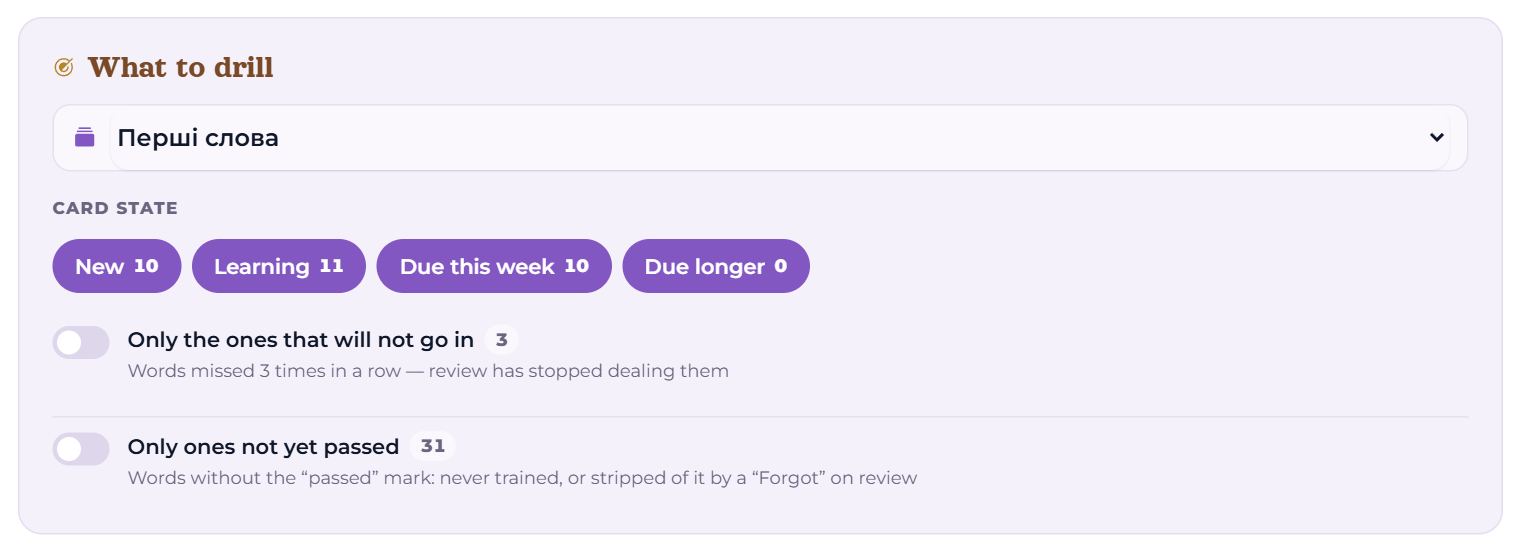
- What to drill — all words of the language picked at the top of the menu, or one of its decks. Other languages are not in the list: switch the language to train them. A paused deck is not trained.
- Card state — which words to take, with counts: New, Still learning, Due this week, Due longer, Not sticking. Several at once is fine. The counts are the ones on My day and Words: a word that is not sticking is counted under “Not sticking” only, never under “Still learning”.
- Only the ones not sticking — only words forgotten three times in a row.
- Only ones not yet passed — words without the “passed” mark: never trained, or stripped of it by a “Forgot” on review.
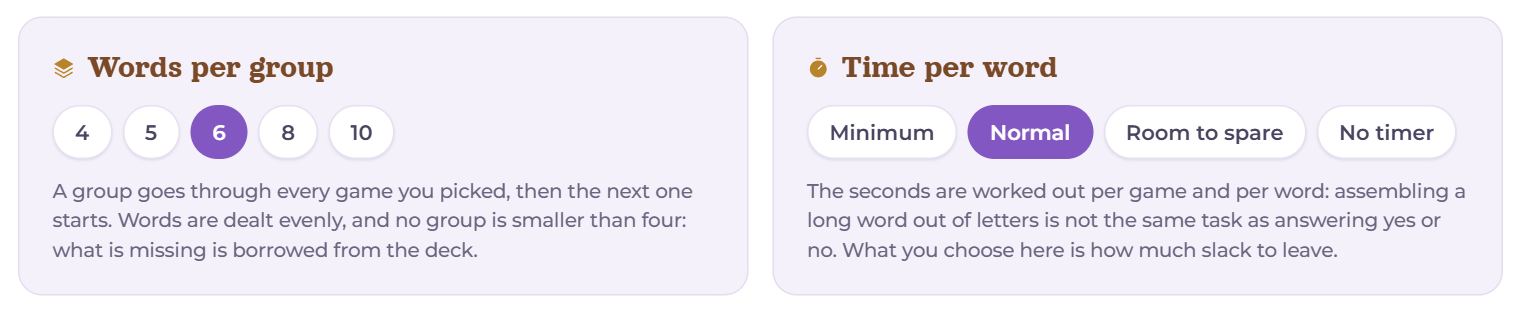
- Words per group — 4, 5, 6, 8 or 10. A group goes through every chosen game, then the next one starts. No group is smaller than four: if words are short, the session tops up with the hardest ones from the deck and says so before it starts.
- Time per word — Minimum, Normal, Relaxed or No timer. The seconds are worked out per game and per word: assembling a long word out of letters is not the same as answering yes or no; here you only choose how much slack to leave.

Word order: As in the deck, Hardest first or Random. Below it, a line about the chosen games and a Change link that opens the other tab.

The bottom always shows what you will get: 31 words · 6 groups · ≈ 18 min, and the Start button.
The Games tab: stages
The games are laid out in four stages — from easier to harder, and in that order they come in every group:
- Meet — The word is in front of you first.
- Recognise — Pick from options.
- Build — Put the word together, with help.
- Check — From scratch, no options.
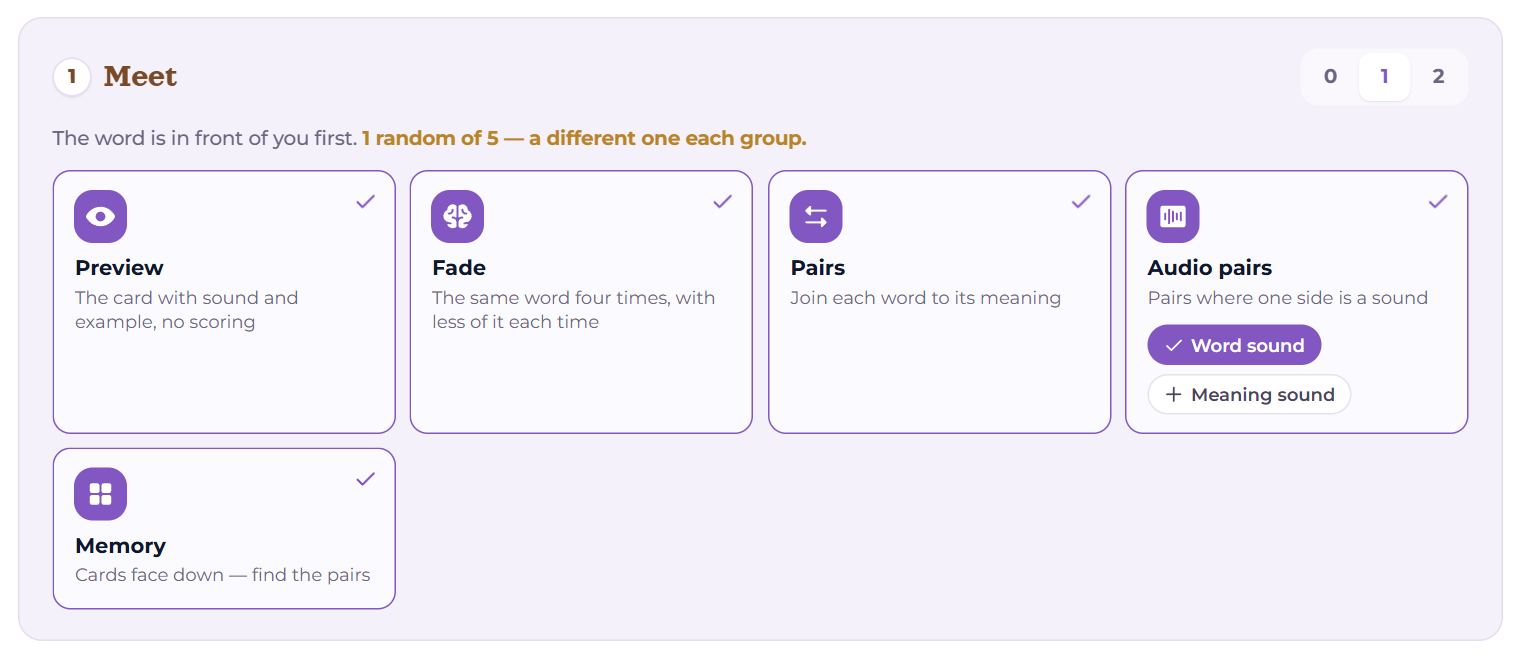
- The 0 · 1 · 2 switch on the right — how many games of this stage each group plays. 0 skips the stage.
- The tiles — which games to draw from; a tick means the game is in. If more are ticked than are played, each group gets different random ones: the line under the stage name says so, for example “1 random of 5 — a different one each group”.
- A game that does not suit a group (say, no recorded words for an audio game) is not skipped silently: another game from the same stage takes its place.
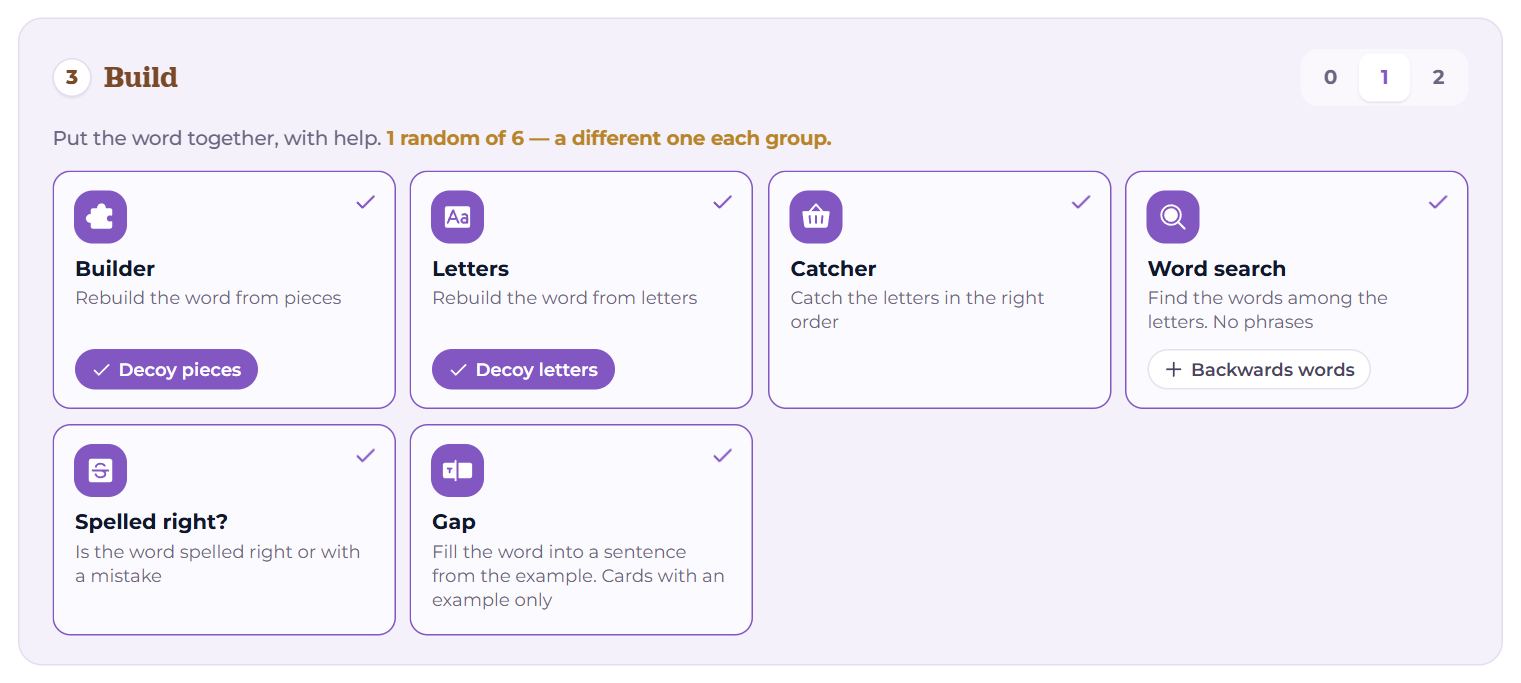
Some tiles have their own options — buttons under the description:
- Builder — Decoy pieces: The heap holds pieces that belong to no word;
- Letters — Decoy letters: The tray holds letters the word does not have;
- Word search — Backwards words: Words also hide right to left and bottom to top;
- Audio pairs — two sides, both can be on: Word sound (A word is played — match it to its meaning) and Meaning sound (A meaning is played — match it to the word).
Every game
Meet
- Preview — The card with sound and example, no scoring
- Fade — The same word up to four times, with less of it each time
- Pairs — Join each word to its meaning
- Audio pairs — Pairs where one side is a sound
- Memory — Cards face down — find the pairs
Recognise
- Audio — Listen and choose
- Sprint — Yes or no, at speed
- Audio sprint — A word is played, a meaning is shown — yes or no
- Bingo — The meaning is played — find the word
- Reverse bingo — The word is played — find the meaning
- What did you hear — Listen and pick the right spelling
Build
- Builder — Rebuild the word from pieces
- Letters — Rebuild the word from letters
- Catcher — Catch the letters in the right order
- Word search — Find the words among the letters. No phrases
- Spelled right? — Is the word spelled right or with a mistake
- Gap — Fill the word into a sentence from the example. Cards with an example only
Check
- Type — Write the word from memory
- Dictation — Write the word you hear
- Odd one out — Three sounds, two meanings — which sound is extra
- Say it — See the meaning — say the word
Sound games only take recorded words. Words without sound can be voiced in the Catalogue: “Missing → no audio”, then “Voice all”.
Choosing games
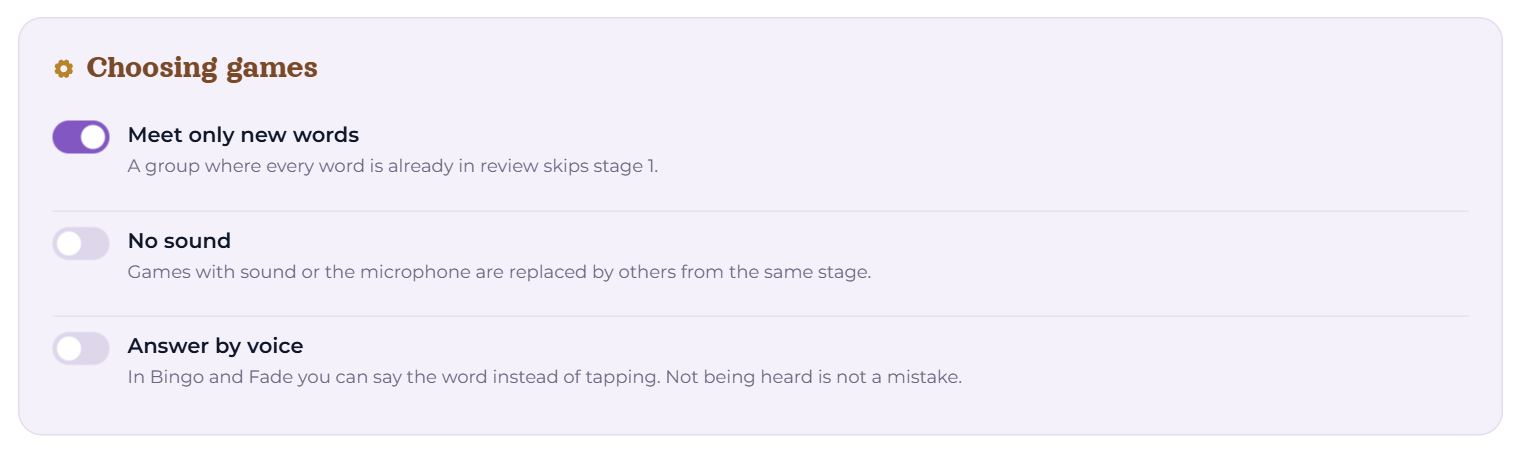
- Meet only new words — A group where every word is already in review skips stage 1.
- No sound — Games with sound or the microphone are replaced by others from the same stage. For when there are no headphones, or the place is quiet.
- Answer by voice — In Bingo and Fade you can say the word instead of tapping. Not being heard is not a mistake. The switch only appears in a browser that recognises speech (Chrome, Safari).

Go over the words that are not sticking — a word missed twice in a group stops the session on that word alone (see below).
During a game
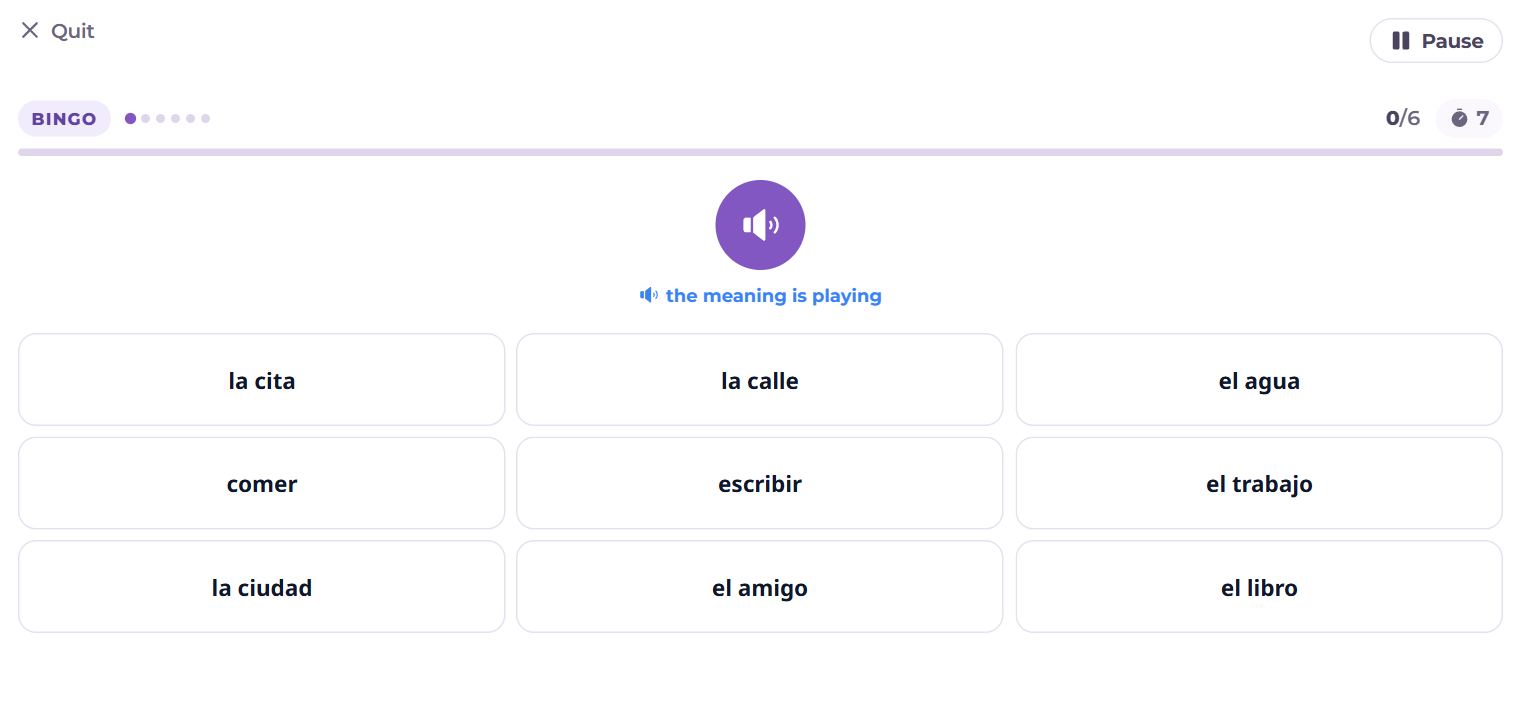
At the top — Quit and Pause; under them, the game’s name, progress dots and the score. Each game says what to do right on the screen; you answer by tapping, from the keyboard or, where possible, by voice.
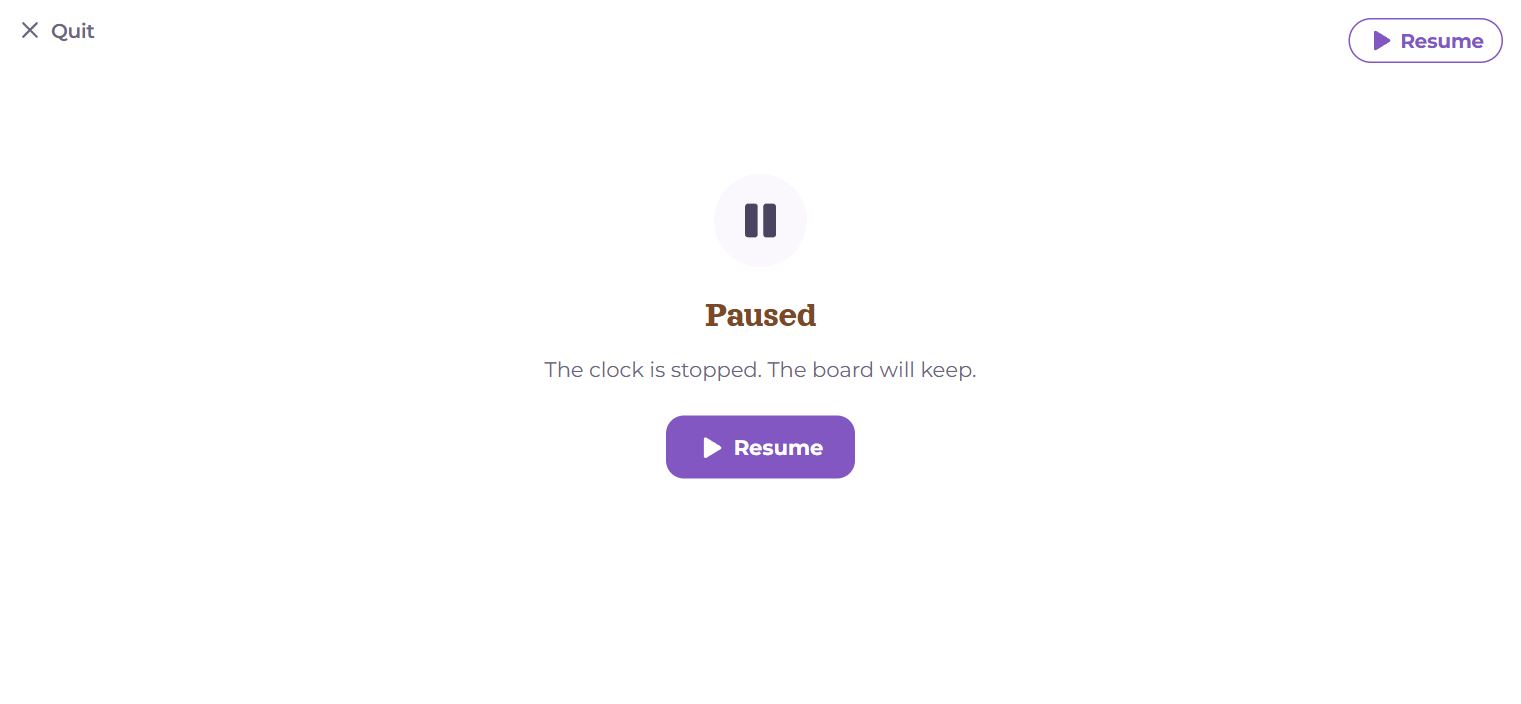
While paused the clock stops and the board stays as it is. If you leave in the middle, the session is remembered: next time, above the setup, there is an An unfinished round card — which group and game, Carry on or Start over.
After each group — how many words went through without a single mistake, Next group or Back to setup. The words of a group played to the end get the “passed” mark.
A word that will not stick
With Go over the words that are not sticking on, a word missed twice stops the game and leads you through four steps:
- Look at it and listen. Say it out loud.
- What does it sound like? Invent an image — yours, any image. You can write the image down — it is saved on the card and shows under “Read more” in review.
- Now copy it, with the word in front of you.
- And now from memory.
Any step can be skipped.
Summary
At the end — how many words, the share of right answers, the minutes and how many words passed. Below, These were the shaky ones: up to eight words with mistakes, and by each one what seems to be in the way for that particular card:
- the translation covers several senses — narrow it or split the card in two;
- you recognise it but cannot write it — Type and Letters are what fix that;
- no picture and no sound; no example; a rare word outside the 20,000 most common;
- training has had its turn already and did not work — better change the card.
A training round cannot be failed — only walked away from. The “passed” mark comes off at the first “Forgot” in review, and the word waits here again.
Questions
- Why did the review schedule not change?
- Training is the exercise, review is the test. If a game with hints moved the intervals, they would grow faster than the word is really remembered.
- Then why does a word from training count toward the day’s goal?
- Because it was recalled. The goal is how many words you recalled in a day, not how many times you pressed “I remember”.
- Are my training settings kept?
- Yes, in this browser: next time the page opens with the same stages and games.