Vocabulary test
In three minutes you see how many words of a language you already know and where to start. The result makes a first deck — the most common words you do not know yet.
Where to take it
- Statistics → What is in the collection → Vocabulary test;
- on My day — in place of the ring while a language has no words yet (Take the test or Not now);
- without an account — at memova.top/test: the result waits until you sign in.
How to answer
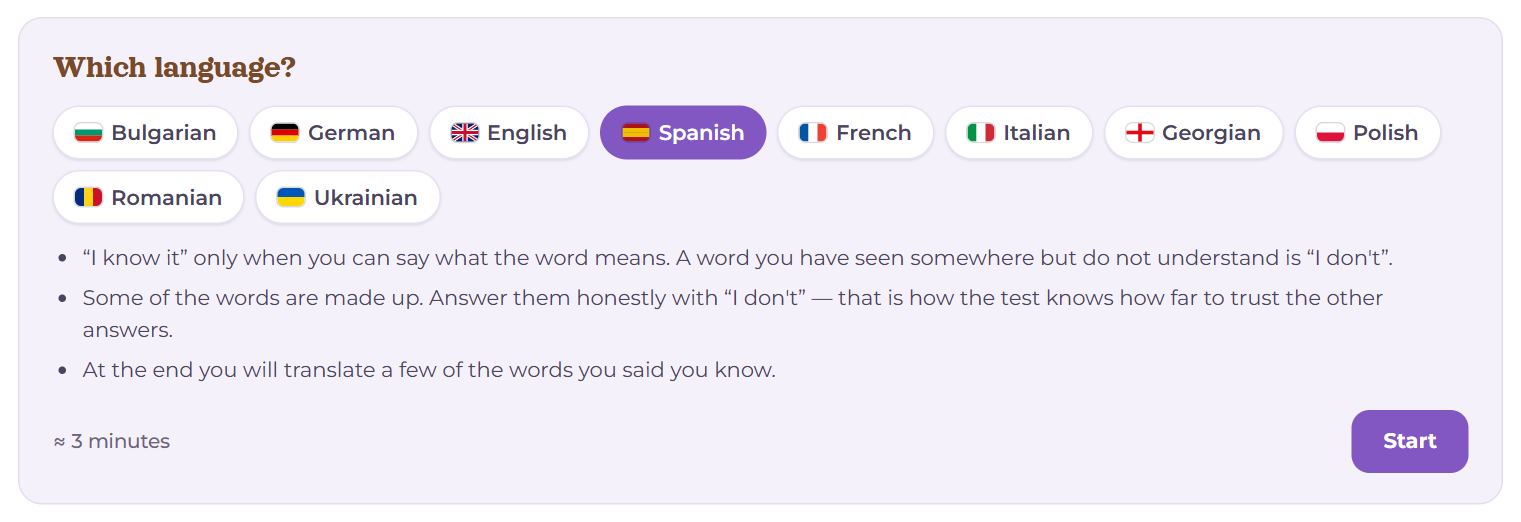
Choose the language — and read the three rules; the accuracy depends on them:
- “I know it” only when you can say what the word means. A word you have seen somewhere but do not understand is “I don't”.
- Some of the words are made up. Answer them honestly with “I don't” — that is how the test knows how far to trust the other answers.
- At the end you will translate a few of the words you said you know.
The test
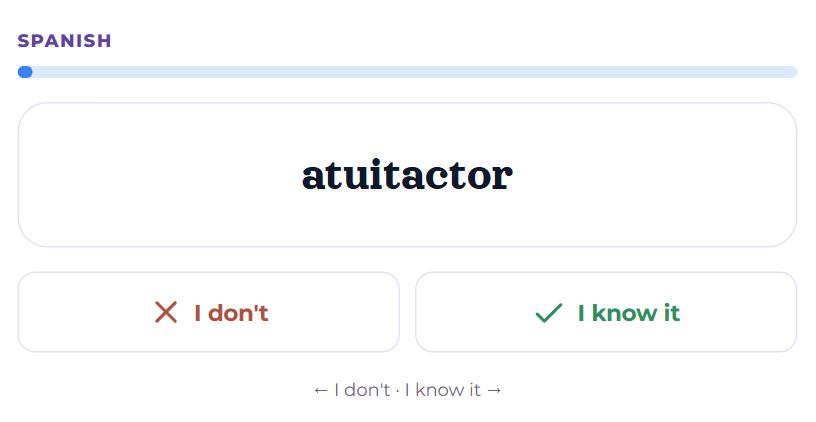
The words go from the most common to the rare ones and adapt to your answers. For each — I know it or I don't; on the keyboard, the → and ← arrows. The bar at the top shows how much is left.
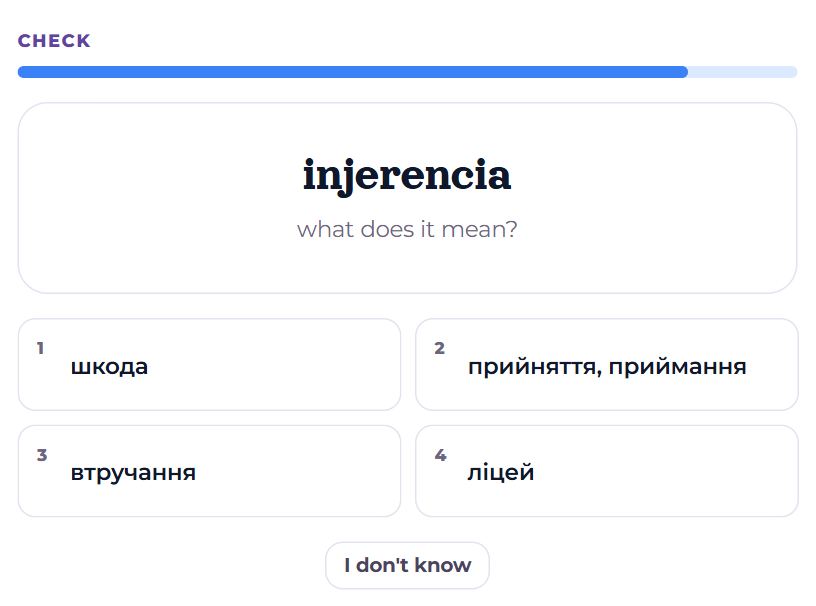
At the end comes the Check: a few words you said you know have to be translated, choosing from four (keys 1–4), or honestly I don't know. This is how the test corrects the estimate when “I know it” was bold.
The result
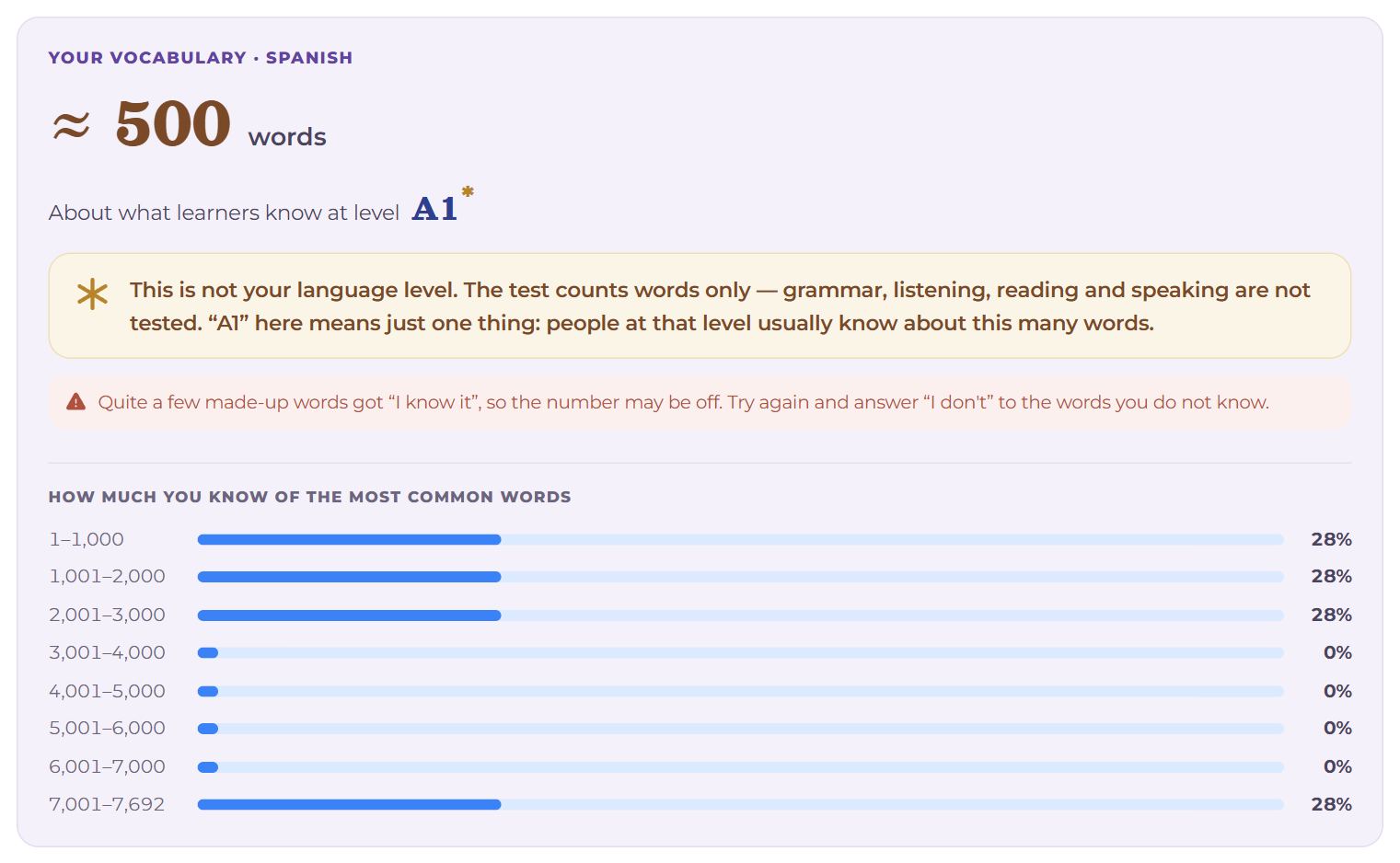
- How many words you know — roughly, rounded.
- About what learners know at level — A1…C2, with a big note: This is not your language level. The test counts words only — grammar, listening, reading and speaking are not tested. “A1” here means just one thing: people at that level usually know about this many words.
- If quite a few made-up words got “I know it”, there is no number: the result says “could not be measured”, and there is nothing to share.
- How much you know of the most common words — the share of familiar words in each thousand: you see where your vocabulary runs out.
A first deck

- Save and add the words — the result is saved, and the 30 most common words you do not know go into “My words”, where every new word lands, voiced at once; the “From the vocabulary test” mark says where they came from. The first two hundred words of every language have hand-made cards: a translation, a short note and an example with its translation, and in time a picture. Words you know are not made into cards.
- Just save — only the result, no deck.
- Take it again.
Without an account, there is Sign in and save instead.
What Memova does with the result
- The word of the day on My day is taken a little past your vocabulary.
- For your level and the library count how many words in a text or a video are new to you.
- Statistics shows how many of the most common words are already in your collection.
You can take the test as often as you like — Memova uses the latest result. Take it again in a few months to see how your vocabulary has grown.
Questions
- Why did it say A1 when I speak more freely than that?
- The test measures only the number of words, not your language level. It does not check grammar, listening, reading or speaking.
- Why the made-up words?
- Someone who presses “I know it” on everything presses it on the made-up words too. They tell the test how far to trust the other answers, and it corrects the number.