How review works
Why a word comes up today, where the intervals come from, and what the goal, the stages and “the pile” mean. No formulas — just enough to understand what happens to your answers.
The idea
A word is not forgotten at once but gradually — and every successful recall pushes the next forgetting further away. So Memova shows a word when you are about to forget it: not earlier (wasted), not later (you would have to learn it again). The schedule is worked out by FSRS — the same algorithm Anki uses: for every word it keeps how firmly it is remembered and how hard it is for you.
What an answer does
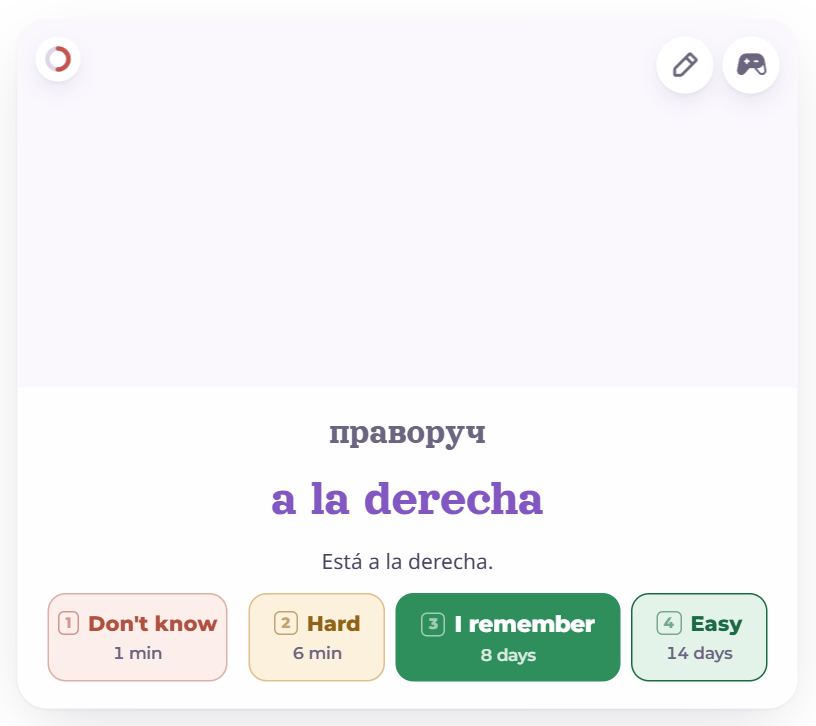
- A new word first goes through learning steps: it comes back in a minute, in ten — still today.
- After the steps it goes into review: in a day or two, then in a week, a month, several months. Every successful answer lengthens the interval.
- Easy lengthens it the most, I remember normally, Hard a little. The buttons show by how much.
- Forgot sends the word back to short steps today, and its next intervals will be shorter than they were.
Training does not move the schedule: the games are the exercise, review is the test.
Retention
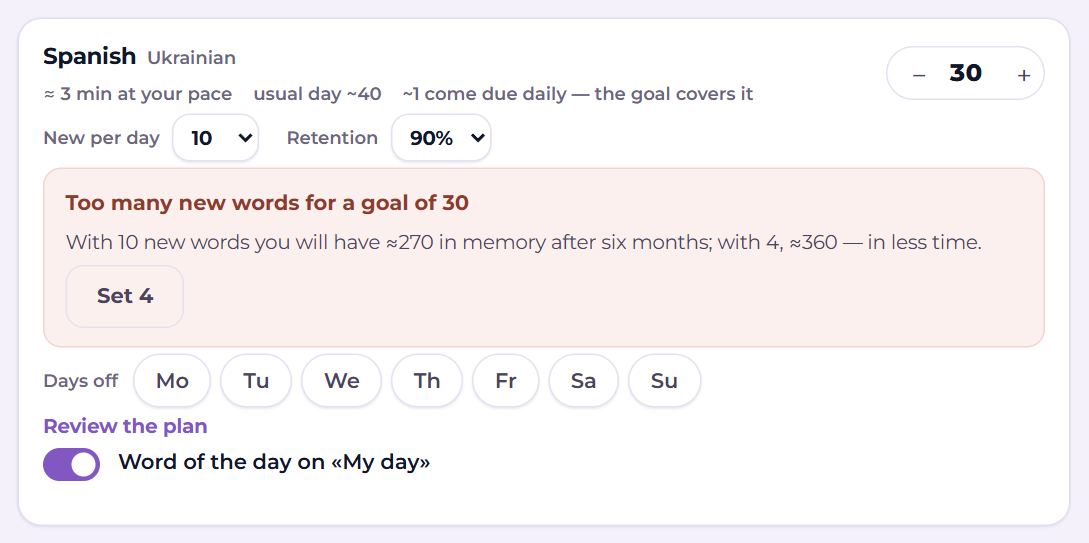
Retention — how likely you should be to recall a word when it comes up. 90% by default. It can be lowered to 88, 86, 84 or 82% — Settings → Study plan, for each language separately.
It is the strongest lever on the daily load: lower retention means longer intervals and fewer reviews, at the cost of a slightly more frequent “forgot”. On a large collection, the difference between 90% and 86% is tens of minutes a day.
Stages
By the interval after its last review, every word is at one of four stages — shown on Words and on the word card:
- New — not shown yet;
- Learning — in learning steps, or remembered for less than two weeks;
- Almost — two weeks to 40 days;
- Learned — 40 days and longer. A learned word is still reviewed, only rarely.
New words
New per day — how many unseen words the session adds every day; they are taken from your decks top to bottom. Every new word means reviews for weeks ahead, so too many new words quickly swell the daily work. When there are too many for your goal, the settings say so — “Too many new words for a goal of 30” — and work out how many words would be in your memory in half a year with fewer, with a button to set that.
Goal and streak
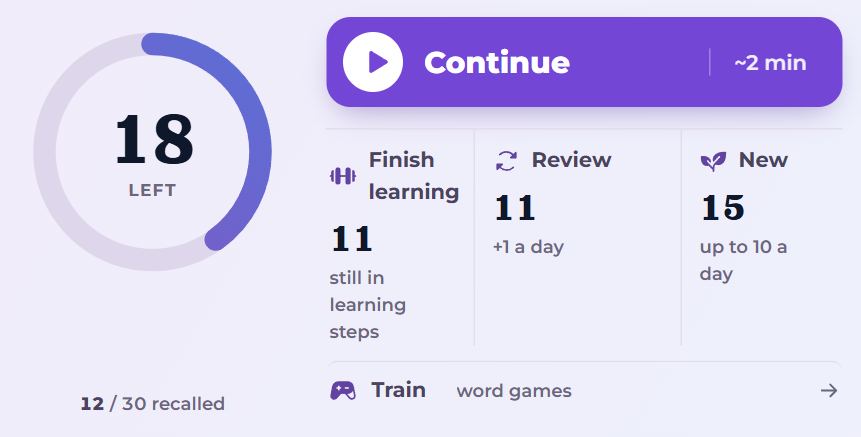
The goal is how many cards you recalled correctly in a day. A card counts once a day, when the answer is better than “Forgot” or when the word went through training. There is one goal per language, and only you change it. The streak is days in a row at goal; days off in your plan do not break it.
Words that will not go in
A word forgotten three times in a row will not get better from more reviews — it only frustrates. So review stops dealing it, and it waits in Training: games from “look at it” to “write it from scratch”. Get it through and it is marked passed, and review takes it again.
The pile
After missed days the overdue words do not disappear — a pile builds up. My day shows when it will be gone at your current goal, and two ways out: raise the goal, or spread the overdue over several days ahead (up to 30), so every day is a little heavier but no word is lost.
Honest ratings
The schedule learns from your answers. “I remember” on a word that came only with a hint stretches the intervals, and the word is forgotten before it comes again. That is why after a hint only “Forgot” and “Hard” are left.
Torn between “Hard” and “I remember”? If you had to think for a few seconds — “Hard”.
Questions
- Why did a word come up when I know it well?
- A well-known word comes up rarely — but it does. Answer “Easy” and next time it will come much later.
- I missed a few days — is everything lost?
- No. Intervals count from your last answer; what was missed simply waits. Spread the pile and in a week or two you are back at your usual pace.
- Will my progress from Anki be kept?
- Yes, Memova uses the same FSRS — see the “Import and export” article.